Directional Drilling Solutions in Hartland, WI
Brookfield sits on some of the most developed real estate in Waukesha County. Bluemound Road, Capitol Drive, Calhoun Road, and the corridors feeding into the Brookfield Square area are dense with paved surfaces, mature commercial lots, and finished residential subdivisions where conventional vertical drilling runs into trouble fast. Directional drilling is what we use when a project cannot accept open excavation or when the target zone sits offset from the only viable entry point on the property. Herr Well Drilling, Inc. has been doing this work in southeastern Wisconsin since 1969, and Directional Drilling has been part of how we handle the harder Brookfield sites for the better part of three decades.
The family started this company drilling vertical wells out of Dousman in the 1960s. Four generations later, the current owners — Nathan, Adam, DJ, and Kendel Domres — added horizontal directional drilling capability to the operation as Waukesha County built out and the work shifted. Directional Drilling is no longer the unusual request it once was around here. In Brookfield specifically, it has become routine.
What We Do
Our work in Brookfield covers residential, commercial, agricultural, and municipal directional drilling applications. That includes horizontal directional drilling beneath roads, parking lots, finished landscaping, and existing structures; angled well drilling for properties where a vertical bore path is blocked by surface conditions or subsurface obstacles; obstacle avoidance drilling on lots where old foundations, abandoned casings, or buried utility networks complicate the subsurface; and precision water source targeting on parcels where the productive aquifer zone is offset from the available drilling location.
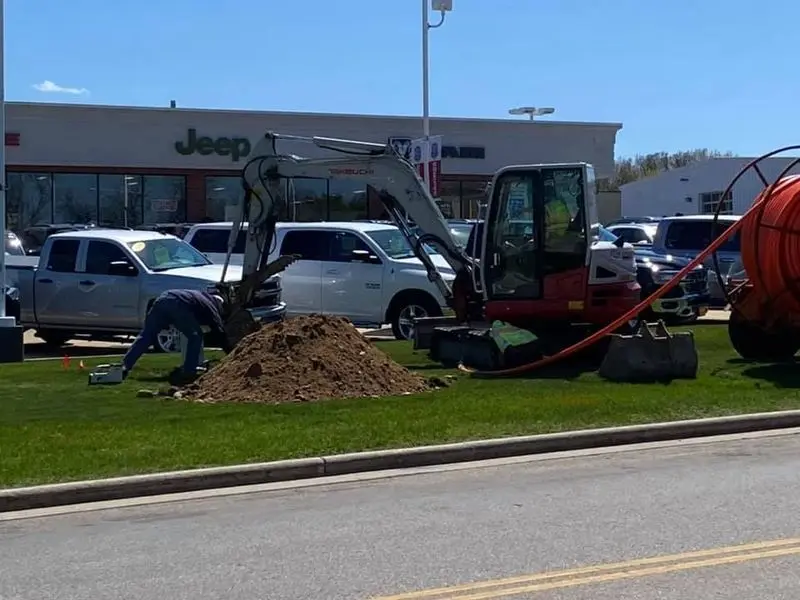
Trenchless utility installation makes up a significant portion of our Brookfield workload. Running water service, conduit, and other underground utilities beneath Bluemound, Moorland, or any of the established commercial frontages without cutting pavement saves the property owner the cost of restoration and saves the surrounding businesses the disruption. The line goes in. The surface stays the way it was. That is the entire point of trenchless drilling, and it applies across most of central Brookfield, where surface restoration costs would otherwise overwhelm the actual installation budget.
Why Brookfield Sites Need This Approach
The geology beneath Brookfield is typical of the region. Glacial till of varying density, layered over fractured Niagara dolomite, with occasional sand and gravel lenses through the upper strata. None of that is unusual for a directional drilling contractor working in southeastern Wisconsin. What makes Brookfield distinctive is the development pattern on top of it.
A property in the older neighborhoods along Gebhardt Road or near Wirth Park is typically not a clean drill site. Decades of utility runs, irrigation systems, and incremental additions to the property have filled the subsurface with surprises. We have hit abandoned pipes, forgotten footings, and buried debris on sites that the property owner believed were straightforward. Directional drilling lets us steer around what is down there. Vertical drilling does not.
Commercial directional drilling in Brookfield brings a different set of constraints. The retail and office corridors along Bluemound cannot accept multi-day surface disruption. Tenants need access. Customers need parking. Horizontal boring under those surfaces, with entry and exit points placed where they cause minimal disturbance, is often the only way the project gets approved in the first place. We have done utility crossings beneath Brookfield commercial frontages where the only visible evidence of the work afterward was a small patch of disturbed turf at each end of the bore.
Key Benefits
Access to constrained locations
Where vertical drilling is not viable due to surface obstructions or subsurface geology.
Minimal surface disturbance
Pavement, landscaping, and finished site features remain undisturbed throughout the project.
Obstacle avoidance
Subsurface boulders, buried utilities, old casings, and existing foundations can be navigated around rather than stopped at.
Precision water source targeting
Geological evaluation identifies productive aquifer zones, and the drill path is designed to reach them accurately.
Trenchless utility installation
Utilities are installed without open-cut disruption to roads, driveways, or finished surfaces.
Applicable across property types
Residential, commercial, agricultural, and utility projects all within scope.
Featured Services
Horizontal Directional Drilling Beneath Developed Surfaces
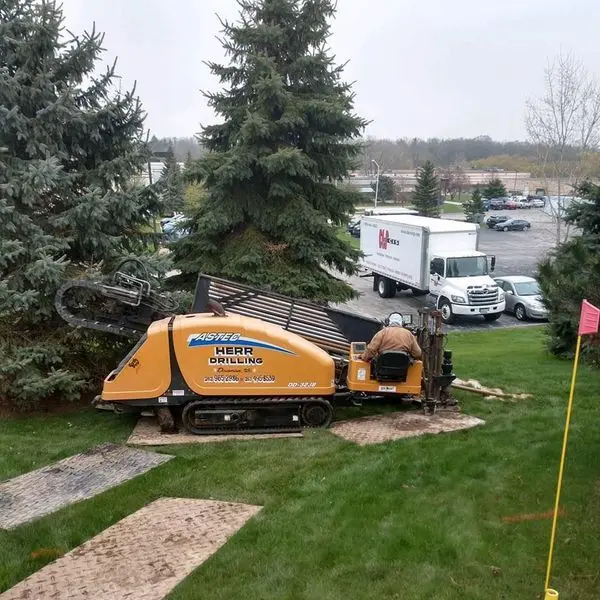
Horizontal directional drilling is the most technically demanding service in this category. It requires equipment built for the purpose, real-time tracking of the bore path, and an operator who reads subsurface conditions and adjusts continuously. We use HDD drilling for utility installations crossing under Brookfield streets, water service entries beneath finished driveways, conduit runs from the right of way into commercial structures, and well access on parcels where the surface entry point cannot be located directly above the target zone. Both residential and commercial scopes are within range.
Angled Well Drilling for Offset Bedrock Targets
When a productive aquifer zone is offset from the available surface entry point, or when a fractured bedrock corridor needs to be intercepted at a specific orientation, angled well drilling is the answer. Brookfield's bedrock is not uniformly productive. Some properties sit above a high-yield fractured zone that runs at an angle to the property line. Vertical drilling on those parcels can miss the productive interval entirely. Angled drilling positions the bore to intercept it accurately. The equipment calibration and depth monitoring required for this work are not interchangeable with standard rig operation.
Obstacle Avoidance Drilling on Built-Out Lots
Brookfield lots built between the 1950s and 1980s often have subsurface complications that owners do not know about until a drill encounters them. Old septic field tile, abandoned sand point wells, buried concrete from previous structures, and uncharted utility laterals all turn up on a regular basis. A vertical rig stops when it hits one of these. Our directional capability allows us to steer around the obstruction and continue toward the target. That difference is what keeps a project moving instead of starting over at a less suitable location.
Trenchless Utility Installation Across Commercial Corridors
Underground utility installation along Brookfield's commercial frontages typically cannot accept open-cut excavation. Trenchless utility installation, also called underground directional drilling, runs the line at depth without disturbing the pavement, sidewalk, or landscaping above. Water service, electrical conduit, fiber, and gas service lines all install this way. Utility directional drilling has been part of how Brookfield property owners avoid the restoration costs that open trenching would otherwise add to the project budget.
Why Brookfield Property Owners Call Us
Most directional drilling companies in this region either focus on utility contracting or on traditional well drilling. The Herr operation does both and has since the 1990s when we first added horizontal capability to a business that started with vertical wells in 1969. That combination matters in Brookfield because the projects here often blur the line between water well installation and utility work. Knowing how to do both, with the same crew and the same equipment, keeps coordination cleaner and accountability clearer.
Our family runs this company directly. The owners are on the rigs, on the phones, and on the job sites. We are licensed by the Wisconsin Department of Natural Resources, fully insured for the work we perform, and accountable for every bore we put in the ground. When something on a Brookfield project requires a judgment call, that call gets made by someone whose name is on the company.
Key Benefits
Property owners searching for directional drilling near me from Brookfield are typically dealing with a site condition that has already stopped someone else or with a planning constraint that ruled out conventional drilling before the project began. The benefits of directional drilling are practical and measurable. Existing surfaces stay intact. Buried obstacles can be navigated around. Aquifer zones offset from the entry point become reachable. Permitting becomes easier on environmentally sensitive parcels because surface disturbance is dramatically reduced. Project timelines hold together because the bore does not have to be abandoned when an obstacle is encountered.
For commercial property owners specifically, the avoided cost of surface restoration after trenchless drilling is typically substantial relative to the cost of the bore itself. That math is what makes horizontal directional drilling the default approach on most Brookfield commercial sites, not the exception.
Service Areas
Our directional drilling services reach Brookfield and the surrounding communities, including Elm Grove, New Berlin, Wauwatosa, Waukesha, Pewaukee, and Menomonee Falls. We operate within a fifty-mile radius of Dousman and serve properties throughout Waukesha County, into Milwaukee County, and across parts of Washington and Jefferson counties for projects requiring horizontal drilling services.
Frequently Asked Questions
What kinds of properties in Brookfield typically need directional drilling?
Most directional drilling calls from Brookfield come from three categories. Developed residential lots where the surface conditions make a vertical bore impractical. Commercial properties along Bluemound, Moorland, or Capitol where the surface cannot accept open excavation. And parcels where a previous contractor identified subsurface obstacles or aquifer geometry that vertical drilling could not address. All three are common in Brookfield given how built-out the city is.
How does Brookfield's geology affect a horizontal directional drilling project?
The shallow subsurface beneath Brookfield is glacial material — clay, sand, gravel, and till in varying proportions — sitting over fractured Niagara dolomite bedrock. Our HDD drilling equipment handles all of those formations. Horizontal directional drilling on Brookfield sites is typically more about navigating around manmade subsurface features from past development than about the natural geology itself.
Does the directional drilling company need to disturb my Brookfield landscaping?
Surface disturbance on a trenchless project is limited to the entry and exit pits of the bore. On most Brookfield residential lots, that means two small areas the size of a card table, both of which restore quickly. The line, conduit, or well runs between them entirely underground. Existing landscaping, hardscape, and pavement between the entry and exit points stay completely undisturbed.
Can directional drilling be used to install a new well on a Brookfield lot too small for conventional drilling?
Often yes. Directional drilling equipment has a smaller surface footprint than a conventional rig in many configurations, and the ability to position the entry point away from the actual target zone gives more flexibility on tight lots. We have completed Brookfield projects on parcels that conventional drillers had already declined. Lot size alone does not usually rule out directional work, though we evaluate each site individually before committing.
What permits are required for a directional drilling project in Brookfield?
Any new well in Brookfield requires a Wisconsin DNR drilling permit. Utility crossings beneath public rights of way require city of Brookfield permits and, in some cases, coordination with the Wisconsin Department of Transportation if a state route is involved. We handle permitting on every project we take on. The property owner does not need to manage that process directly.
How long does a horizontal directional drilling project typically take in Brookfield?
A single trenchless utility crossing on a Brookfield residential lot is usually a one-day operation. Commercial utility installations along Bluemound or Capitol frontages typically run one to three days depending on bore length and depth. Directional well drilling projects generally run two to four days. Site access and traffic management on busier corridors can add time, which we factor into the schedule before work begins.
Is angled well drilling actually different from standard well drilling on a Brookfield property?
Yes, meaningfully so. A standard well drops straight down from the surface entry point. An angled bore is positioned at a controlled deviation from vertical to reach a target zone that is offset from where the surface drilling can take place. The equipment, the bore path planning, and the depth monitoring all differ. We use angled well drilling on Brookfield parcels where the only viable surface entry is not directly above the productive aquifer interval.
How do I know if my Brookfield property actually requires directional drilling rather than a conventional well?
A site assessment answers that question. We look at lot dimensions, access points, existing site features, available geological data for the parcel and surrounding area, and any history of past drilling attempts on the property. Some Brookfield sites are straightforward vertical drilling jobs and we say so. Others genuinely require directional capability and we recommend it. The honest answer comes from looking at the site, not from making assumptions over the phone.
Ready to Discuss a Brookfield Project?
If your Brookfield property has site conditions that ruled out conventional drilling, or if you have a planned project that needs trenchless installation, call Herr Well Drilling at 262-965-2986. We will look at the site, review what is known about the subsurface, and give you a straightforward assessment of whether directional drilling is the right approach and what it will involve.